sectionSpanner [14084886]
- www.cs.princeton.edu/courses/archive/fall16/cos418/docs/P6-Spanner.pdf
- Worldwide LTP, SQL semantics, horizontal scalability, availablity, transactional consistency
-
Parts
- Client
- Load balancer
-
Zone - between 100 and a few thousand servers
- Zone manager
- Placement driver, responsible for automated data transfer between zones
-
Location proxy
- Uses the per zone location proxies to find spanservers for data
-
Universe manager
- For interactive debugging
- Spanserver - consists of tablets
- Colossus - distributed file system that stores tablet's state similar to B-tree format
1. Design
1. Design
- Spanner is deployed as "universes", and only a few are active at one time
- Each one relies on TrueTime to provide strong external consistency and global serialization
- Also performs automatic resharding based on data size and load
- Universe manager and placement driver are both singletons, although there are shadow replicas that will take over
-
Each zone works like a cluster of bigtable servers, each spanserver has several tablets ranging from 100-1000
- (key:string, timestamp:int64) -> strings
- paxos and TrueTime are used to cover time, and Colossus is used to store data
-
Each tablet stores metadata and logs for the state machines, and the paxos implementation supports time-based leaders with long-lived leaders (aka fastpaxos)
- Single leader fast paxos effectively function as raft
-
Concurrency is handled via a lock table
- Each server enforces concurrency control based on the long-lived paxos leader
- Paxos leaders have around 10s for their leases
- Paxos group that has a participant leader that acts as the transaction manager, and the other replicas are participant followers.
- For transactions that span multiple groups, a coordinator is elected
- Note that we only lock for writes
- bully algorithm is used for leader election
1.1. Writes and Reads
1.1. Writes and Reads
- When a write is done, the lease vote is automatically extended, and leaders need to ask for a lease extension.
- Notably, it waits out the uncertainty before proceeding with a commit
- To serve reads, each replica in Spanner keeps track of the maximum timestap that it was up to date. When a read transaction comes in, it decides whether it's able to serve it
- Commit protocol guaranteees that all nodes know the lower bound of a prepared transaction timestamp.
- We have to assign a timestamp for a snapshot reads, and snapshot reads are only done on replicas that are up to date
2. Database Buckets
2. Database Buckets
-
Spanner has an additional layer of abstraction over the bag of key-value mappings in the form of a directory or bucket
- All adjacent keys that begin with the same prefix
- All the data in the same bucket shares the same replication settings
- Move frequently accessed buckets into the same paxos group or place a bucket geographically closer to its accessors
- Spanner buckets differ from Bigtable ones because they don't need to be lexicographically contiguous
- We can
movedirbuckets across Paxos groups, which then moves the data in the background. The metadata setting is then flipped in the background RCU style -
We use a bucket to specify the geographical replication attributes and placements
-
Two settings:
-
Total number and type of replicas
- You can tune the amount of voting replicas and place them physically closer
- Read only - can't vote, only allow for scaling reads
- Witness - Vote for the leader and commit write transactions, but don't keep a copy of the data. Can't serve as read leaders
- Read-write replicas - Does both, can be a leader
- Geographic placement of replicas
-
-
3. Data Model
3. Data Model
- SQL-like, but Megastore had poor performance
4. truetime
4. truetime
- With truetime, any two transactions T1 and T2,m if T2 begins to commit after T1 completes committing, then T2's timestamp is > T1's timestamp
- Consistent timestamp allows easy snapshot isolation, since we can just read at a point in tiem
- Liskov, Barbara. “Practical Usesof Synchronized Clocks Undistributed Systems,” n.d.
5. CAP theorem and spanner
5. CAP theorem and spanner
- does not guarentee uptime, but real databases need maint anyways, so it is "essentially CA"
- Since paxos is used, it opts for consistency over availability, as paxos is possible to livelock
6. DB Transactions
6. DB Transactions
6.1. Read Transactions
6.1. Read Transactions
- For read transactions, we buffer them on the client side until commits.
- Transactions writes are not visible to subsequent reads inside the same transaction
-
Uses wound-wait to prevent deadlocks
- Read request
- The lead replica acquires a lock
- Read to update to date data from the replicas
-
For read-only transactions
- within a single paxos groups: just send the read transaction to the group's leader
-
if it's multiple paxos groups: then determine the $s_{read}$ value on the last timestamp by doing consensus with leaders
- Or avoid the consensus round
6.2. Uses a 2PC
6.2. Uses a 2PC
- Guarentees isolation and strong consistency
- If participants in a 2PC are physically nearby, then it selects paxos groups closer
- Leader who aren't coordinators gets access to write locks, and then also does prepare timestamps
-
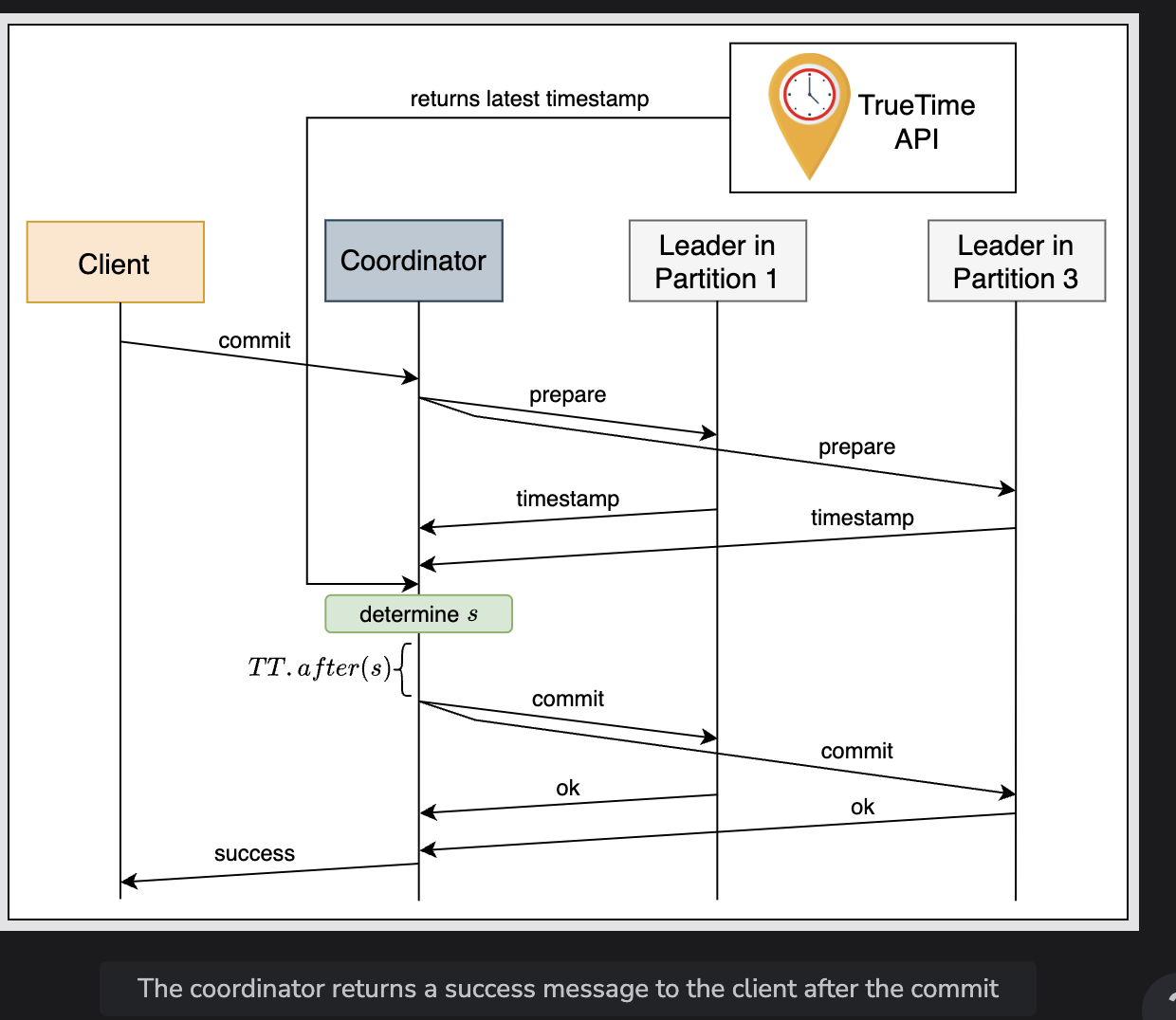
Coordinator roles
- The coordinator bypasses the prepare step and gets locks for writes, and recieves inputs from all the group's leaders
-
Commit transactions
- Greater than or equal all prepare timestamps to satisfy the invariants of read-write transactions
- Greater than TT.now().latest
- Greater than the timestamps of all the transactions that the leader coordinator has assigned previously
6.3. Schema Change Transactions
6.3. Schema Change Transactions
-
Changing the schema in Spanner
- A future timestamp is determined in the prepare phase
- Consider that the t is the timestamp of a registered schema change transaction
7. Eval
7. Eval
- Important thing to understand about spanner is TrueTime, by putting bounds on clock drift, you acn get transactions
8. Spanner SWE Tea Series
8. Spanner SWE Tea Series
-
Spanner was ultimately based off of F1, which had implemented quite a bit of this before
- Shute, Jeff, Radek Vingralek, Bart Samwel, Ben Handy, Chad Whipkey, Eric Rollins, Mircea Oancea, et al. “F1: A Distributed SQL Database That Scales.” Proceedings of the VLDB Endowment 6, no. 11 (August 27, 2013): 1068–79. doi.org/10.14778/2536222.2536232.
- interesting secret sauce was about how they retry requests
- F1 previous had to fetch the entire protobuf value to do a partial decode
- Spanner wasn't originally SQL, but they decided to do quite a bit of pushdown as a result
-
Becoming a SQL system (Bacon, David F., Nathan Bales, Nico Bruno, Brian F. Cooper, Adam Dickinson, Andrew Fikes, Campbell Fraser, et al. “Spanner: Becoming a SQL System.” In Proceedings of the 2017 ACM International Conference on Management of Data, 331–43. Chicago Illinois USA: ACM, 2017. doi.org/10.1145/3035918.3056103.)
-
range extraction and pushdown
-
static decomposition of SQL down into
scan,filter, andapplyprimitives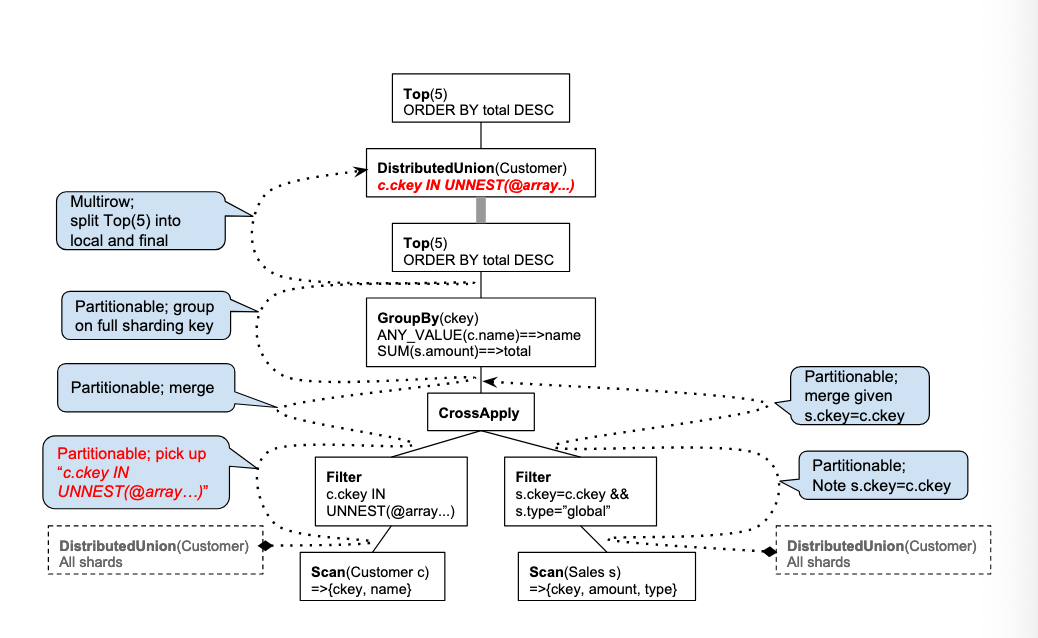
-
- ressi
-
shard pruning
- location hints about the location of a particular shard
-
restart token
- not much mentioned but this seems to be the secret sauce here
-