un and global governance lecture 12 [779e6ef7]
Tags: UN and Global Governance
1. Joseph Galtun
1. Joseph Galtun
- IMF and World Bank - unholy trinity
2. mali
2. mali
- coup
- UN mandate is unrelated to the mali coup
- sequencing in what peacekeeping should be doing and asking who is dirivng the peacebuilding process?
- more targeted and specific interventions
-
gap between level of intervention (scale) and what it attempts to do
- what the end state should look like
3. lecture
3. lecture
- vast majority of states reconstructed has been democratic state
- seems to be an end-state in what peacebuilding looks like
- supporting role of the UN government makes it easier on UN to shirk their responsbilities
-
shifting conflict prevention
- moving from patching emergencies to preventing conflict from happening
4. readings
4. readings
-
political barriers of conflict prevention
-
RC system
- is this conservative?
- runs into challenges for political reasons
- hard to sell, people are not interested in conflicts that may or may not emerge
-
intra-state conflict has greatly surged
- internationalized interstate conflict
-
-
aspects of prevention
- conflict prevention is more localized
- seeking to address capacity issues
- Cliffe: UN Peace and Security Reform praises the reorganization
-
managing short term priorities while also mitigating the long term risks
- lack of respect for human rights
- important of coalition, prevention must be a collective effort
-
concepts:
-
prevenative diplomacy
- narrow focus, clear trigger, works by shifting decision-making calculations of conflict actors away from violence
- move actors away from the local and try to get a comprimise
-
structural violence prevention
- what are the structural conditions that contribute to the onset of conflict?
- how do we transform these structures?
- largely solidified
-
-
evolution
- Dag Hammarskjold
- Perez de Cuellar
- Bourtros Boutros-Ghali
- Kofi Annan
- Ban Ki-Moon - restructuring
-
Antonio Guterres - prevention became THE priority
-
prevention ops is much larger, almost the size of peace operations
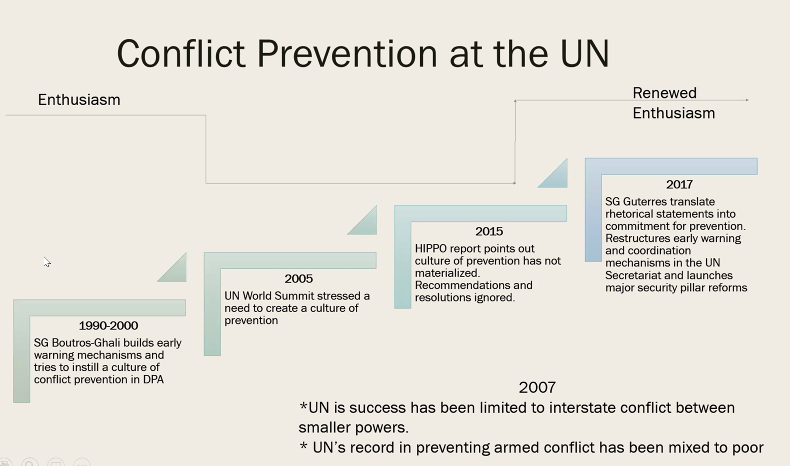
-
- when do host governments spoil peace?
- should allocations go to near term emergencies?
-
been a demand for mediation experts
- is this workable? can mediators be dispatched anywhere?
- bureaucratic misalignments in structural prevention
-
reform plan from Gueterres
- still assessing whether the decoupling has a good impact
- prevenative diplomacy has shrunk, this has been regrowing
5. questions
5. questions
-
causing of funding with engagements from local actors
-
strategic frameworks is done every two years, across the board entites that recieve regular budget (aka from member state dues)
- specific member states are very interested in funding initiatives such as gender or sexual based violence
-
existing multi-donor trust fund
- goes hand in hand with technical assistance
- remains to be seen if the member states
-
-
lots of readings focus on diplomatic solutions
- is there a role or benefit forceful action?
-
carrot and stick strategy has no consistency
-
multidimensional peacekeeping missions in the democratic republic of the congo (DRC), in every iteration since 2006
- issues with local actors not trusting MONUSCO
-
-
how much is funding involved in prevention plans? how much can be expected of the UN in conflict prevention?
- existing trust fund
- started to shift certain departments
-
emphasis on power sharing agreements
- what are they modeled on?
- liklihood of breakdown
- nonconsolidation of democracy
- "sustaining" is the operative word
-
dealing with the binary of peace/non-peace
- moving to hybrid notions of how to co-opt
- social cohesion to build "resilence", but only one layer
- very troublesome, still powerbase driven, lack of curiosity
-
disapora - less so with the UN, focused on a statist approach
- more promentiant on smaller NGO's
- the UN is focused on spoilers to the peace process, not specifically power players
- what is the role f