ICS Training [b2ed4e54]
Tags: disaster response
1. What is ICS?
1. What is ICS?
- Used for all kinds of incidents, applicable for all events, not only just for emergencies
- Establishes common processes for incident level planning
- Used to manage any type of incident
2. ICS (IS-100)
2. ICS (IS-100)
-
National Incident Management System
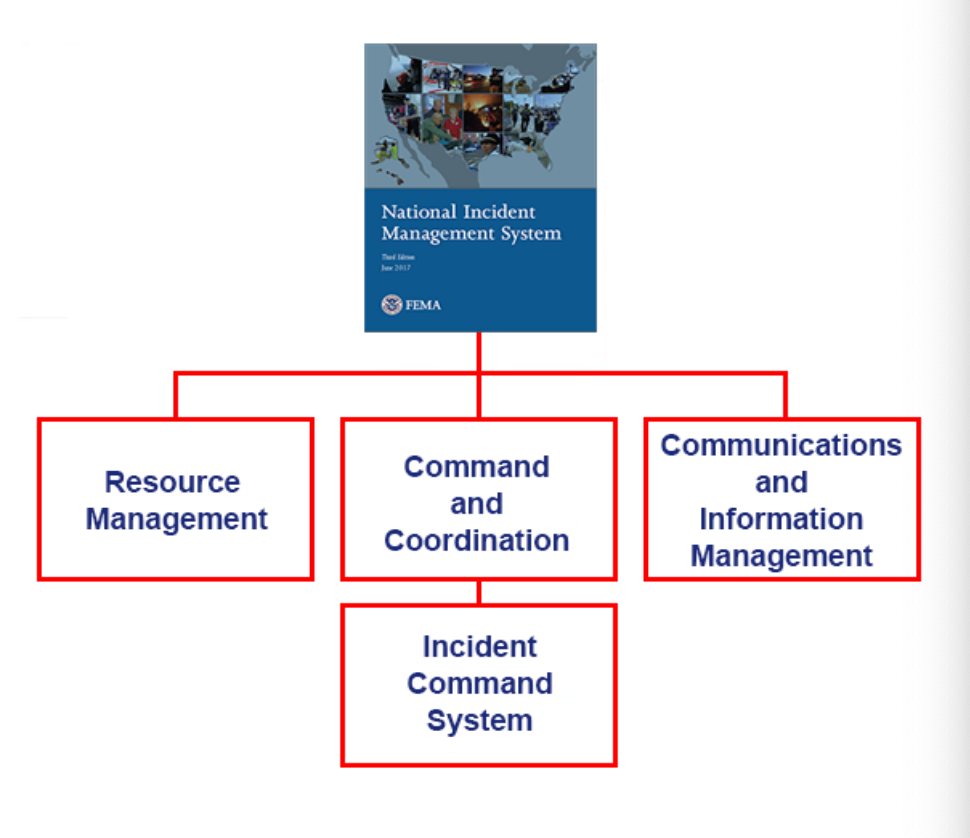
- Gives a unified chain of command
- Managable span of control
- Establishes common terminology
2.1. Incident Action Planning
2.1. Incident Action Planning
2.1.1. Managable Span of Control
2.1.1. Managable Span of Control
- Refers to number of individuals that one supervisor can manage effectively during an incidient
2.1.2. Comprehensive Resource Management
2.1.2. Comprehensive Resource Management
Entails:
- Resource identification
- Qualification and certification of personnel
- Planning for resources
- Acquiring, storing, and inventorying resources
2.1.3. Establishment and Trasnfer of the Chain of Command
2.1.3. Establishment and Trasnfer of the Chain of Command
- Command function should always be established at the beginning of an incident
- Transferring command during incidient should include a briefing that captures all essential information
2.1.3.1. Unified Command
2.1.3.1. Unified Command
- Established when there are multiple agencies, where no single jurisdiction exists that has the authority to manage the incident on its own
2.1.3.2. Chain of command
2.1.3.2. Chain of command
-
Allows incident comander to direct and control the actions to avoid the incident
- Q-> snafucatchers?
- Avoids confusion by requiring that orders flow from supervisors
2.1.3.3. Unity of command
2.1.3.3. Unity of command
- Refers to overall hierarchy of organizational command
-
Each person
- Reports to one ICS supervisor
- Recieve work assignments only from the ICS supervisor
- Prevents confusion based on titles
2.2. Accountability
2.2. Accountability
Multiple principles
- Checkin/checkout
- Incident Action Planning
- Unity of command
- Personal responsibility
- Span of control
- Resource tracking
2.3. Five Major ICS functional areas
2.3. Five Major ICS functional areas
-
Command
- Sets incident objectives, strategies, and priorities
-
Operations
- Conducts operations to reach incident objectives
-
Planning
- Support by tracking resources, collecting/analyzing info, maintaining documentation
-
Logistics
- Arranges for resources and needed services to support achievement of the incident objectives
-
Finance/Administration
- Monitors costs related to the incident
-
Intelligence/Investigations
-
6th ICS function
- Used only for intensive intelligence gathering or investigative activity
-
2.3.1. Incident Command
2.3.1. Incident Command
-
Act of directing, ordering, or controlling the incident response
-
ICS uses an incident commander, who has the authoirty to establish objectives, make assignments, and order resources
- Always staffed in ICS applications
-
-
Responsible for
- Ensuring overall incident safety
- Providing information services
- Establishing and maintaining liasons
- May assign deputies that can fully take over the role
- Should be clearly established at the beginning of an incident
- Modular, IC should be able to assume other roles
-
Depending on size, 3 additional roles may include
-
Public Information Officer
- Interfaces with public/media and other agencies
-
Safety Officer
- Monitors incident operations and advises the IC on all matters relatin g to safety
-
Liaison Officer
- Serves at the incident commander's point of contact for representitives of gov agencies
-
2.3.2. Incident Coordination
2.3.2. Incident Coordination
-
Ensure that ICS organization receives the info, resources, and support needed
- Establishing policy based on interactions with agencies and other stakeholders
- Collect, analyzing, and disseminating information to support establisment of shared situational awareness
- Establishes priorities among incidents
- Resolving critical resource issues
- Facilitating logistics support & resource tracking
- Synchronizing public information messages
2.3.2.1. Emergency Operations Center
2.3.2.1. Emergency Operations Center
- EOC's
- Physical or virtual location where staff come together to address threats and hazards
- Staffed with personnel trained for, or authorized to, represent their agency/discipline
- Equipped with mechanisms for communicating with the incident site
- Providing support to the incident by obtaining resources
- Applicable at different levels of gov
2.3.2.2. Joint Information Center
2.3.2.2. Joint Information Center
- JIC
- Established to coordinate all incident-related public information activities
2.4. General Staff Roles
2.4. General Staff Roles
-
May establish 4 additional sections (ops, planning, logistics, finance/admin)
- Each section has a designated section chief
-
Ops should be first established
- Others are about planning the incident response
- Ops is responsible for developing strat and tactics
- Responsible for staging areas
-
Planning
- Prepare and disseminate incident action plan
- Track resources
-
Logistics
- Provides facilities, services, and material support
- Critical on more complex incidents
-
Finance
- Financial and cost analysis
- Contract negotiation, and documenting claims
- ICS organizational structure is based on resource requirements
2.4.1. Operations
2.4.1. Operations
- Implementing strategies and developing tactics to carry out the incident objectives
- Directing the management of all tactical activities
- Supporting the development of the incident action plan
- Organizing, assigning, and supervising the tactical response
2.4.2. Planning
2.4.2. Planning
- Only developed after there is a need for a planning section
- Preparing and documenting incident action plans
- Managing information and maintaining situational awareness
- Tracking resources
- Maintaining incident docs
- Developing plans for demobilization
2.4.3. Logistics Section
2.4.3. Logistics Section
- Ordering, obtaining, maintaining, and accounting for personnel, equipment, and supplies
- Providing communication planning and resources
- Setting up food services for responders
- Setting up and maintaining incident facilities
- Providing support transportation
- Providing medical services to incident personnel
2.4.4. Finance/Admin section
2.4.4. Finance/Admin section
- Contract negoitation and monitoring
- Timekeeping
- Cost analysis
- Compensation for injury or damage to property
- Documentation for reimbursement
3. NIMS (IS-700)
3. NIMS (IS-700)
3.1. NIMS resource management
3.1. NIMS resource management
3.1.1. Typing Resources
3.1.1. Typing Resources
- Establishes common definitions for the capabilities of personnel, equipment, teams, supplies, and facilities
-
Capability
- Resource's capability to perform its function in Prevention, Protection, Mitigation, Response, and Recovery
-
Category
- Function for which a resource would be most useful
-
Kind
- Broad characterization, st personnel, equipment, teams, and facilities
-
Type
- capacity to perform its function based on size/power/capacity/experience/qualifications. Type 1 has greater capacity than type 2, 3, 4
3.1.2. Credentialing Personnel
3.1.2. Credentialing Personnel
- Qualifiying: personnel meet the minimum established standards to fill positions
- Certification: recongition that an individual has completed qualificatoin or a position
- Credentialing: documentation (ID card or badge)
3.1.3. Planning for resources
3.1.3. Planning for resources
- Stockpiling, mutaual aid agreements, determining how and where to reassign resources, developing contracts to acquire resources from vendors
3.1.4. Resource Management
3.1.4. Resource Management
-
Identify requirements
- Type and quanitity of resources needed
- Locations where resources should be sent
- Who will receive and use the resources
-
Order and Acquire
- Find out resources that are local or request from other places
-
Mobilize Personnel and other resources begin mobilizing when notified through established channels
- Date/time/place of departure
- Mode of transportation to the incident
- Estimated date and time of arrival
- Reporting location and assigned supervisor
- Anticipated incident assignment
- Anticipated duration
- Resource order #
- Incident number
- Cost and funding codes
-
Track and Report
- Helps track the location of resources
- Helps staff prepare to receieve and use resources
- Protects the safety and security
- Enables resource coordination and movement
-
Demobilize
- Resources should reassign or demobilize as soon as they are not needed
-
Reimburse and Restock
- Establish and maintain readness of resources
- Collect bills and validate costs
- Ensure resource providers are paid in a timely manner
3.1.5. Mutal Aid
3.1.5. Mutal Aid
- Sharing of resources and services between jurisdictions or organizations
- Established the legal basis for two or more entities to share resources
- Authorized across a wide range of actors, between cities, states, ngo's, communities, agencies, internationally, etc
- Aid can be declined that do not meet its needs
3.2. NIMS Management Characteristics
3.2. NIMS Management Characteristics
- Same as ICS except
-
Area commands
- Established based on overseeing multiple incidents or large/evolving situation
- Relevant to situations with several Incident Command Posts (ICPs) requesting similar, scarce resources
3.3. Emergency Operations Centers (EOCs)
3.3. Emergency Operations Centers (EOCs)
- Used to manage on-scene, tactical-level response, off site locations where staff come to address immiment issues
-
Varying duties, including:
- Collecting, analyzing, and sharing information
- Support resource needs and requests
- Coordinating plans and determining current & future needs
- Providing coordination and policy direction
3.3.1. Configuration of EOCs
3.3.1. Configuration of EOCs
- Many configured like the standard ICS structure, with command team, ops, planning, logi, and finance/admin
- May also opt to use their day-to-day deparmental agency structure
-
Activated for variety of incidents
- Multiple jurisdictions
- Incident commander or unified command indicates incident could expand rapidly
- Similar incident had EOC precendence
- EOC director or offical directs EOC activation
- Inicident is imminent
- Threshold events described in emergency ops plan
- Significant impacts to the population are anticipated
3.3.1.1. Activation Levels
3.3.1.1. Activation Levels
- Multiple activation levels to allow for scaled response
-
Levels
-
3
- Normal for the EOC, watch and warning activiations
-
2
- Certain EOC team members are activated to monitor a credible threat, risk or hazard
-
1
- Full activation
-
3.4. Other NIMS Structures
3.4. Other NIMS Structures
3.4.1. MAC Group
3.4.1. MAC Group
- Multiagency coordination groups
- Sometimes called policy groups
- Act as a policy-level body
- Support resource prioritization and allocation
- Make cooperative multi-agency decisions
- Enable decision making among elected and appointed officials and the IC
3.4.2. JIS
3.4.2. JIS
- Joint information system integrates incident information and public affirs into a unified organization that provides consistend, coordinated, accurate, accessible timely, and complete inofmration to public and stakeholders
- Develop and deliverying coordinated interagency messages
- Develop, recommend, and executing public information plans and strategies
- Advise on public affirs issues
- Addressing and managing rumors and inaccurate information
3.4.2.1. JIS components: PIO and JIC
3.4.2.1. JIS components: PIO and JIC
-
PIO (public information officier)
- Advises the IC, Unified Command, or EOC director on public infomration
- Gathers, verifies, and coordinates accurate, accessible, and timely information
- Handle sinquirings from the media/public/elected officials
- Providing emergency public information and warnings
- Conducting rumor monitoring and response
-
JIC
- Central location that houses JIS operations and public information statff perform essential information
3.4.2.2. Informing Public and Stakeholders
3.4.2.2. Informing Public and Stakeholders
- Gather, Verify, Coordinate, and Disseminate
3.5. Communications and Information Management
3.5. Communications and Information Management
-
Interopability
- Capacity for emergency management and response personnel to interact and work together
- Communciate across jurisidictions and organizations, via voice, data, and video, in real time
-
Reliability, Portability, and Scalability
- Reliable - familiar to users, adaptable to new technology
- Portable - can effectively be transported, deployed, and integrated
- Scalable - Able to expand to support situations
-
Resiliency and Redundancy
- Resilency - system can withstand and continue to perform after damage or loss of infrastructure
- Redundancy - When primary communication methods fail, duplicate systems enable continuity through alterate communication methods
-
Security
- Information is sensitive
3.5.1. Communication Types
3.5.1. Communication Types
-
Strategic
- High level directions
-
Tactical
- Communications between and among on-scene command and tactical personnel
-
Support
- Coordination of support of strategic and tactical communications
-
Public
- Alerts and warnings, press conferences
3.5.2. Incident Information
3.5.2. Incident Information
-
Reports
- Situation Report (sitrep): regular reports that contain information regarding the incident status during the past operational period and the specific details for an incident
- Status report: reports such as spot reports, that include vital or time sensitive info. More function specifically and less formal than sitreps
-
Incident Action plans
- Plans containing incident objectives established by IC or UC and addressing tactics and support activities
-
Data collection and processing
-
Follows
- Rapid assessment
- Data collection plans
- Validation
- Analysis
- Dissemination
- Updating
-