LeCun, Bengio, Hinton - Deep Learning [62dcf06c]
LeCun, Yann, Yoshua Bengio, and Geoffrey Hinton. “Deep Learning.” Nature 521, no. 7553 (May 2015): 436–44. doi.org/10.1038/nature14539.
1. Summary
1. Summary
Deep learning uses multiple layers to learn representations of data with multiple levels of abstraction
1.1. Supervised Learning
1.1. Supervised Learning
- most common
- show inputs and annotations
- create an objective function that measures errors
-
most people use stochastic gradient descent
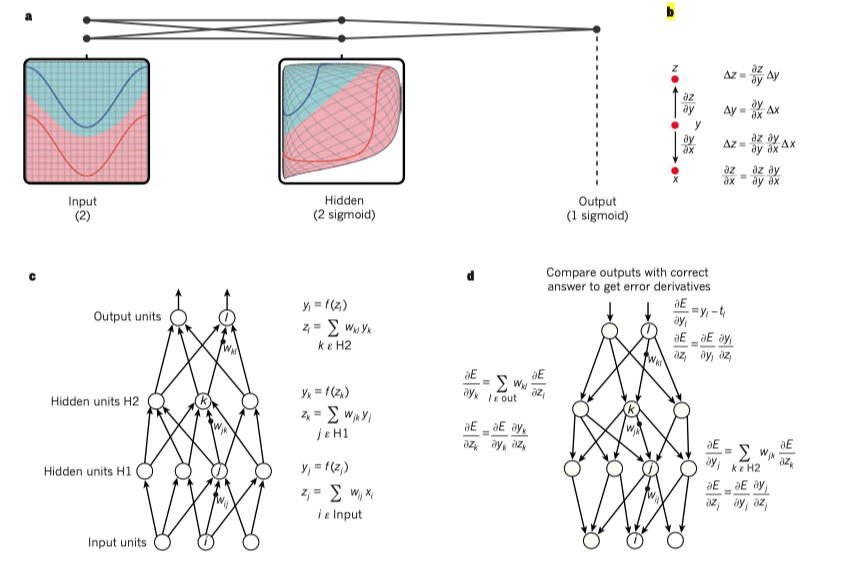
- known since 1960 that linear classifers only carve their input space into very simple regions (half spaces separated by a hyperplane)
- multiple non-linear layers from 5-20, system can implement extremely intricate functions
1.2. Backprops for multilayer
1.2. Backprops for multilayer
- the derivative of the objective with respect to the input of a module can be computed by working backwards from the gardient wrt to the output of that module
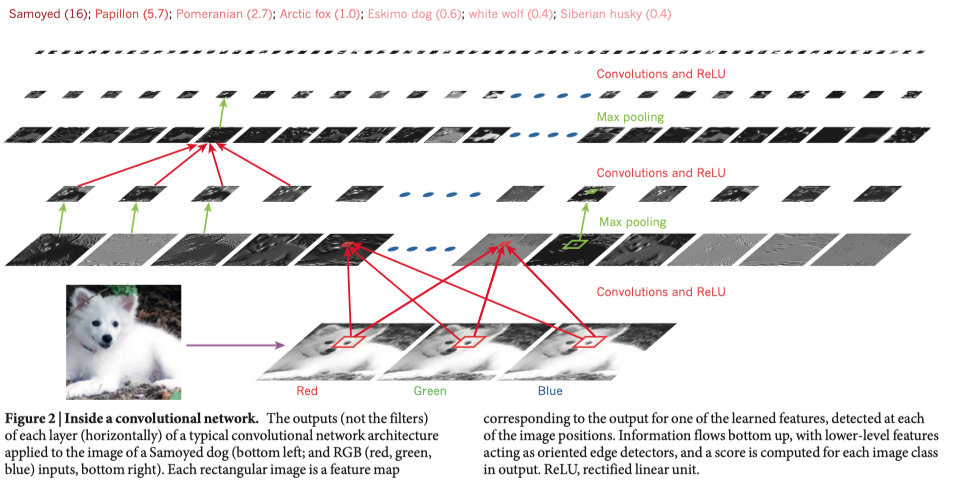
- ReLu maps fixed-size input to fixed-size output
-
late 1990's commonly thought that simple gradient descent would get caught in local minima
- rarely a problem for gradient descent in practice