Outcomes: {1, 2, 3}
Let the probabilities be p1,p2,p3.
We know that p1≥0, p2≥0, p3≥0, and p1+p2+p3=1.
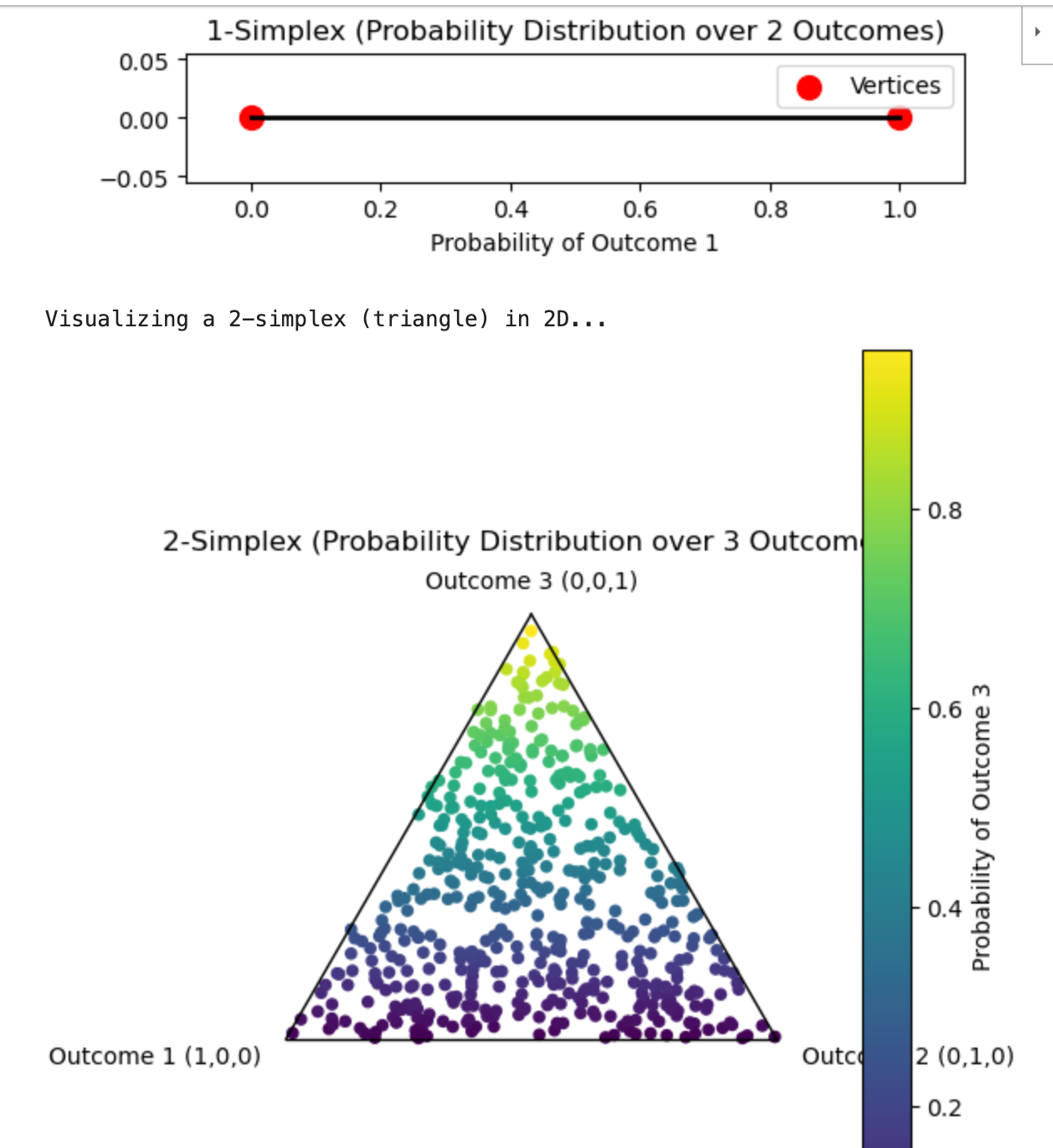
Geometrically, this can be represented by a 2-simplex, which is an equilateral triangle.
Each vertex of the triangle represents a distribution where one outcome has a probability of 1 and the others have a probability of 0.
Vertex 1: p1=1,p2=0,p3=0
Vertex 2: p1=0,p2=1,p3=0
Vertex 3: p1=0,p2=0,p3=1
Any point inside the triangle (or on its edges) represents a probability distribution where p1,p2, and p3 are non-negative and sum to 1. The closer a point is to a vertex, the higher the probability of that corresponding outcome.